Zero-Shot and Few-Shot learning in virtual agents


Summary
Training an intelligent virtual assistant usually takes large amounts of data and time. This article explains how zero-shot and few-shot models reduce that effort: zero-shot models understand intents without training examples, while few-shot models need only a handful. It compares the two approaches and helps teams decide which one suits their virtual assistant development.
What’s on this page
Keeping up with growing customer expectations is a tough battle for businesses. Customers have no loyalty and one or two bad experiences lead them to look to your competitor. How do you keep winning in such situations? Technology! Specifically, bringing AI-powered experiences to the enterprise that deliver an exceptional customer experience.
Intelligent virtual assistants (IVA) powered by artificial intelligence (AI) automate and optimize customer experiences efficiently. However, a successful IVA typically requires extensive training, which can be time-consuming and expensive.
The Kore.ai Artemis Platform, in its latest release, addresses these hurdles with the power of large-language models (LLMs) and generative AI technologies in Zero-shot and Few-shot learning models.
These models perform tasks on new, unseen data with limited to no training on that specific task. It is possible because these models are pre-trained on billions of data points and can make accurate predictions on new and unseen data. They enable more efficient and effective use of available data while reducing the amount of manual effort required for labeling and training models. Let us explore them further.
Zero-Shot Model
The Zero-Shot Model is a powerful tool that can help businesses build and deploy IVAs without any training and achieve rapid development. This is useful in situations where there are many possible outcomes, and collecting labelled data for all of them would be impractical or impossible.
In the Kore.ai Artemis Platform, the model integrates with the Open AI GPT models, which allows it to process customer requests efficiently. Without prior training, the model can identify intents and extract entities from customer requests, making it easier for virtual assistants to provide accurate responses. By eliminating the need for training, businesses can reduce costs and speed up development. Customers can enjoy a superior conversational experience without waiting for the virtual assistant to be trained.
Let us explore how to use the model -
- The model allows users to define the intent that needs to be identified. The Intent names must be more descriptive for the model to perform efficiently, like "Dispute credit card transaction."
- User should enable the Zero-Shot Network Type during the training process.
- The system identifies the most appropriate intent by matching the user's statement with the defined intent names without needing training statements. It then responds with the relevant intents.
- Intents identified by the Zero-Shot model are considered definitive matches.

Here are a few considerations while using the Zero-Shot Model -
- You must provide the API key to integrate the Kore.ai Artemis Platform with OpenAI. Intent names and user utterances will be shared with OpenAI.
- It's important to note that the Zero-Shot network type only applies to the machine learning (ML) engine, not the fundamental meaning (FM), knowledge graph (KG), or traits engines. The platform continues to use patterns for intent matching by the FM engine.
- When Zero-Shot is enabled, all matches from the ML engine are considered definitive.
- The default definite score is set to 80% based on natural language processing (NLP) performance and accuracy.
The zero-shot model leverages the integration with OpenAI to identify the intents and generate responses. That means the information is shared with OpenAI for processing and responding, it might be a concern in some cases, and, you’ll have to purchase an OpenAI license separately.
To overcome these challenges, Kore.ai has also introduced the Few-Shot Model, a more powerful model that leverages an open-source LLM hosted within the Kore.ai server.
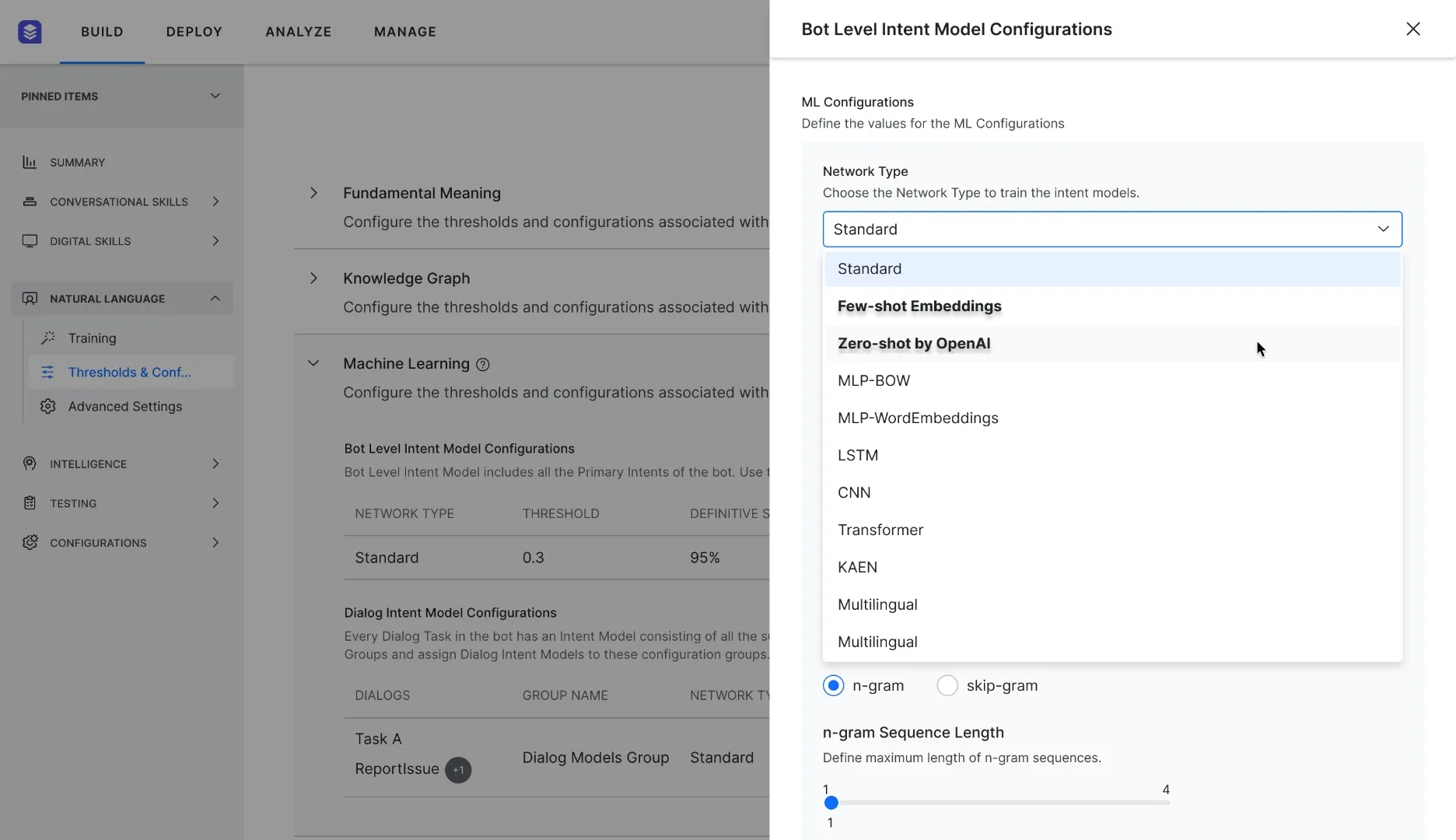
Few-Shot Model
The Few-Shot Model also leverages the power of large language models and eliminates or minimizes training efforts. Unlike the Zero-Shot Model, the Few-Shot Model allows you to provide training using task names; it is much faster than traditional models. Only 1/10th of the necessary training is required to put it into operation. That means a 10x increase in development speed!
The model utilizes Kore.ai's custom fine-tuned LLM pre-trained with large data sets to handle customer requests, which delivers greater consistency in responding to customer requests. Additionally, the model is robust and secure, as it does not share data with third-party sources and does not require additional activation costs.
Here are a few considerations while using the Few-shot Model -
- Disable ‘Multiple Intent Models‘ and configure the minimum ML Threshold to 0.6 and ML Definitive Score is set to 90% (0.9).
- Disable ‘Rescoring of Intents‘
- ‘ML Suggestion Proximity‘ (for ML Engine) is added to the list by default with a value set to 5.
- Exact Task Name Match‘ (for FM Engine) is added to the list by default and set to the Disabled state.
Which one is best suited for your IVA development?
Both the Zero-Shot and Few-Shot Models are designed to help businesses speed up their conversational AI journey and provide superior customer experiences. However, the best choice will depend on the specific needs and goals of each individual business.
When considering the Zero-Shot model, businesses should keep in mind that it is best suited for simple tasks, such as answering frequently asked questions or providing basic information. The model may not be as effective for more complex tasks that require a deeper understanding of the customer's needs.
On the other hand, the Few-Shot model is better suited for complex tasks and handles disambiguation and false positives, as it requires some training to operate effectively. Businesses can provide additional training as needed, which makes it a more flexible option. Additionally, the model's ability to deliver consistently high performance can help businesses provide a more personalized experience for their customers.
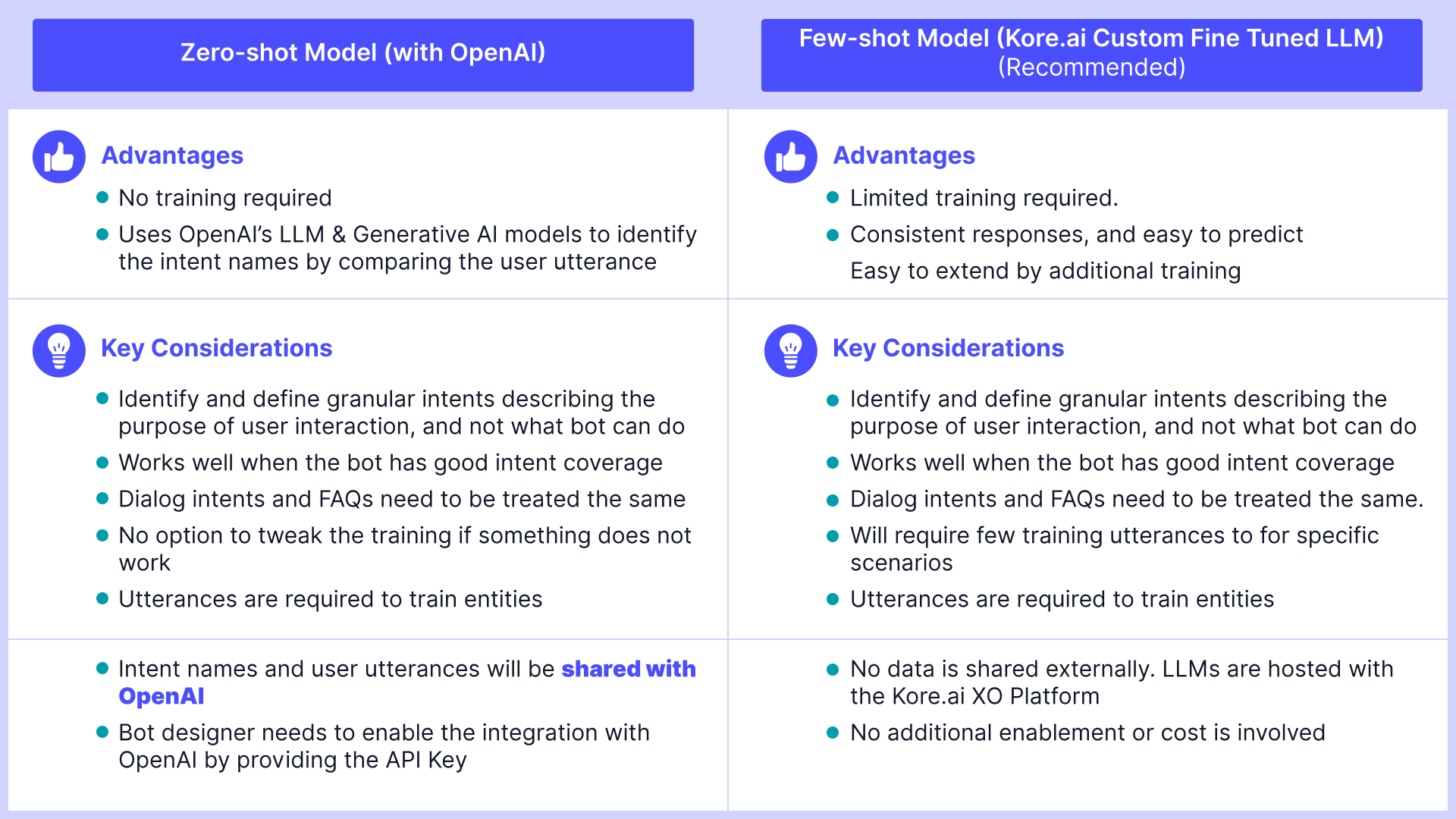
Both models offer benefits and drawbacks, and businesses should carefully consider their needs before making a decision. However, it is clear that these models can help businesses achieve their goals more efficiently and effectively.
In conclusion, intelligent virtual assistants are a valuable medium for businesses looking to provide top-notch customer service. The Zero-Shot and Few-Shot Models offer new ways to achieve this goal, without requiring extensive training or high costs.
Kore.ai Artemis Platform has revolutionized IVA development by introducing these flexible and effective models; they can help businesses to positively engage with their customers anywhere anytime. By carefully considering their needs and goals, businesses can choose the model that best suits them and achieve success in this competitive market.
FAQ
1. What is zero-shot learning?
Zero-shot learning is an AI technique that enables models to perform new tasks without receiving task-specific training examples.
2. What is few-shot learning?
Few-shot learning is an AI technique that enables models to perform specific tasks using a small number of labeled examples.
3. What is the difference between zero-shot and few-shot learning?
Zero-shot learning requires no task-specific examples, while few-shot learning uses a limited number of examples to improve task understanding and performance.
4. Which is better: zero-shot or few-shot learning?
Zero-shot learning is suitable for rapid deployment, while few-shot learning can offer better performance for domain-specific tasks that require additional context.
5. How do LLMs support zero-shot and few-shot learning?
Large language models leverage pretrained knowledge and contextual understanding to perform new tasks with minimal or no task-specific examples.
Share
Tags